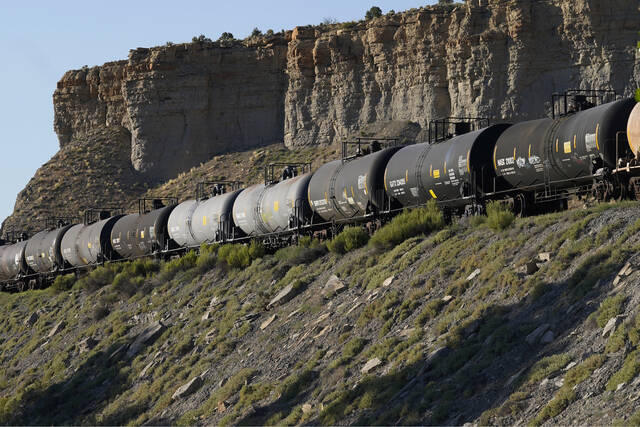
WASHINGTON — The Supreme Court backed a multibillion-dollar oil railroad expansion in Utah Thursday in a ruling that scales back a key environmental law for projects around the country.
The 8-0 decision comes after an appeal to the high court from backers of the project, which is aimed at quadrupling oil production in the remote area of sandstone and sagebrush.
Environmental groups said the decision would have sweeping impacts on National Environmental Policy Act reviews. The Trump administration has already said it’s speeding up that process after the president vowed to boost U.S. oil and gas development.
The case centers on the Uinta Basin Railway, a proposed 88-mile expansion that would connect oil and gas producers to the broader rail network and allow them to access larger markets. Supporters have argued that streamlining environmental reviews would speed up development.
The justices reversed a lower court decision and restored a critical approval from federal regulators on the Surface Transportation Board. The project could still face additional legal and regulatory hurdles.
Environmental groups and a Colorado county had argued that regulators must consider a broad range of potential impacts when they consider new development, such as increased wildfire risk, the effect of additional crude oil production from the area and increased refining in Gulf Coast states.
The justices, though, found that regulators were right to consider the direct effects of the project, rather than the wider upstream and downstream impact. Justice Brett Kavanaugh wrote that courts should defer to regulators on “where to draw the line” on what factors to take into account. Four other conservative justices joined his opinion.
“Simply stated, NEPA is a procedural cross-check, not a substantive roadblock,” he wrote of the policy act reviews. “The goal of the law is to inform agency decision making, not to paralyze it.”
The court’s conservative majority court has taken steps to curtail the power of federal regulators in other cases, including striking down the decades-old Chevron doctrine that made it easier for the federal government to set a wide range of regulations.
Justice Sonia Sotomayor agreed with the outcome, but with a narrower legal reasoning. In a decision joined by her two liberal colleagues, she said the court could have simply cleared the way for the railway approval by finding the board didn’t need to take into account any harm caused by the oil that might eventually be carried on the railway.
Justice Neil Gorsuch did not participate in the case after facing calls to step aside over ties to Philip Anschutz, a Colorado billionaire whose ownership of oil wells in the area means he could benefit if the project goes through. Gorsuch, as a lawyer in private practice, had represented Anschutz.
The ruling comes after President Donald Trump’s vow to boost U.S. oil and gas drilling and move away from former President Joe Biden’s focus on climate change. The administration announced last month it’s speeding up environmental reviews of projects required under the same law at the center of the Utah case, compressing a process that typically takes a year or more into just weeks.
“The court’s decision gives agencies a green light to ignore the reasonably foreseeable consequences of their decisions and avoid confronting them,” said Sambhav Sankar, senior vice president of programs at Earthjustice.
Wendy Park, a senior attorney at the Center for Biological Diversity, said opponents would continue to fight the Utah project. “This disastrous decision to undermine our nation’s bedrock environmental law means our air and water will be more polluted, the climate and extinction crises will intensify, and people will be less healthy,” she said.
The project’s public partner applauded the ruling. “It represents a turning point for rural Utah — bringing safer, sustainable, more efficient transportation options, and opening new doors for investment and economic stability,” said Keith Heaton, director of the Seven County Infrastructure Coalition.