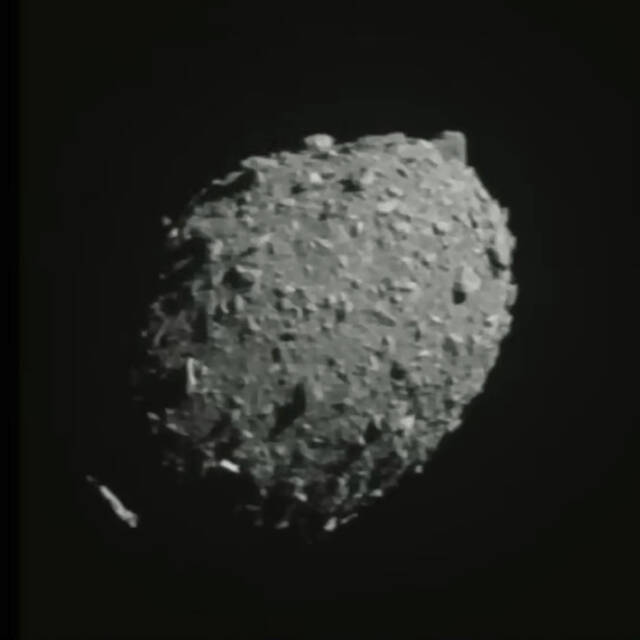
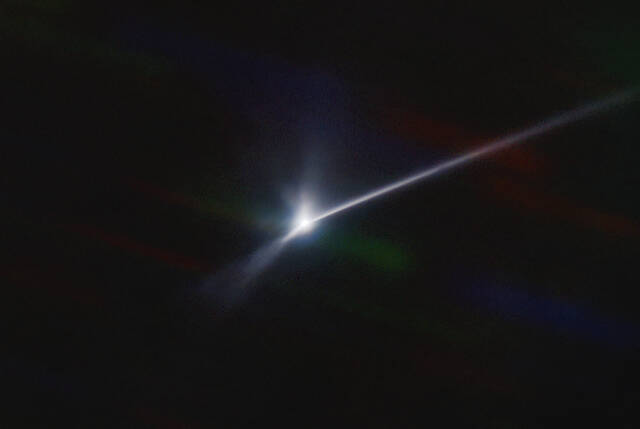

CAPE CANAVERAL, Fla. — A spacecraft that plowed into a small, harmless asteroid millions of miles away succeeded in shifting its orbit, NASA said Tuesday in announcing the results of its save-the-world test.
The space agency attempted the test two weeks ago to see if in the future a killer rock could be nudged out of Earth’s way.
“This mission shows that NASA is trying to be ready for whatever the universe throws at us,” NASA Administrator Bill Nelson said during a briefing at NASA headquarters in Washington.
The Dart spacecraft carved a crater into the asteroid Dimorphos on Sept. 26, hurling debris out into space and creating a cometlike trail of dust and rubble stretching several thousand miles. It took days of telescope observations from Chile and South Africa to determine how much the impact altered the path of the 525-foot asteroid around its companion, a much bigger space rock.
Before the impact, the moonlet took 11 hours and 55 minutes to circle its parent asteroid. Scientists had hoped to shave off 10 minutes but Nelson said the impact shortened the asteroid’s orbit by about 32 minutes.
The amount of debris apparently played a role in the outcome, scientists said. The impact may also have left Dimorphos wobbling a bit, said NASA program scientist Tom Statler. That may affect the orbit, but it will never go back to its original orbit, he noted.
Neither asteroid posed a threat to Earth — and still don’t as they continue their journey around the sun. That’s why scientists picked the pair for the world’s first attempt to alter the position of a celestial body.
Planetary defense experts prefer nudging a threatening asteroid or comet out of the way, given enough lead time, rather than blowing it up and creating multiple pieces that could rain down on Earth.
“This is spectacular that we’ve taken this first step … but we really need to also have that warning time for a technique like this to be effective,” said mission leader Nancy Chabot of Johns Hopkins University’s Applied Physics Laboratory, which built the spacecraft and managed the $325 million mission.
“You’ve got to know they’re coming,” said NASA’s Lori Glaze.
Launched last year, the vending machine-size Dart — short for Double Asteroid Redirection Test — was destroyed when it slammed into the asteroid 7 million miles away at 14,000 mph.
“We’ve been imagining this for years and to have it finally be real is really quite a thrill,” said Statler.