SEOUL, South Korea — The black boxes of a Boeing jetliner that crashed in South Korea last month stopped recording about four minutes before the accident, South Korean officials said Saturday, possibly complicating investigations into the cause of the disaster that killed 179 people.
After analyzing the devices, the U.S. National Transportation Safety Board concluded that both the flight data and cockpit voice recorders stopped working about four minutes before the crash, the South Korean Transportation Ministry said.
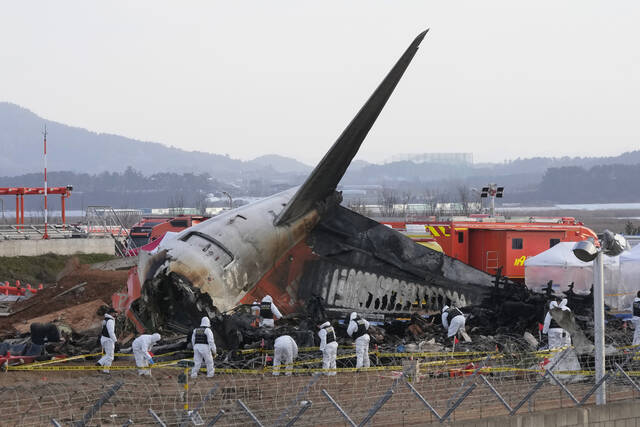
The Boeing 737-800 operated by Jeju Air skidded off a runway in the South Korean town of Muan on Dec. 29 after its landing gear failed to deploy, slamming into a concrete structure and bursting into flames, killing all but two of the 181 people on board.
After initially analyzing the black boxes, South Korean officials sent the devices to the NTSB for closer examination after discovering that some of the data was missing. The transportation ministry said it wasn’t immediately clear why the devices failed to record data in the last four minutes.
“Data from the CVR (cockpit voice recorder) and FDR (flight data recorder) are crucial in investigating accidents, but such investigations are conducted through the examination and analysis of various sources of information, and we plan to do our utmost to determine the cause of the accident,” the ministry said in a statement.
South Korean investigators have said that air traffic controllers warned the pilot about possible bird strikes two minutes before the aircraft issued a distress signal confirming that a bird strike had occurred, after which the pilot attempted an emergency landing.
South Korean officials have also pledged to improve airport safety after experts linked the high death toll to Muan airport’s localizer system, the structure hit by the aircraft as it crashed. The localizer, a set of antennas designed to guide aircraft during landings, was housed in a concrete structure covered with dirt on an elevated embankment. This has raised questions about whether the structure should have been built with lighter materials that would break more easily upon impact.