
FORT LAUDERDALE, Fla. — They’re more comfortable, but they don’t work too well.
Plastic face shields, neck gaiters and masks with valves — three of the creative approaches to face coverings since covid-19 hit the United States — are not very effective in curbing the spread of coronavirus particles, according to two new studies from Florida Atlantic University in Boca Raton.
FAU engineering researchers tested how well shields and several types of masks worked on mannequins whose simulated coughs and sneezes were mapped to determine their path through the air.
Although several studies have shown the effectiveness of different face coverings, the FAU researchers used distilled water and glycerin to simulate the blast of particles from a human mouth, and lasers that provided striking neon graphics to illuminate the droplets’ track. They published their research in the journal Physics of Fluids.
Here’s what they found:
Without a mask, droplets traveled more than 8 feet, further than the 6-foot distancing guideline recommended by the U.S. Centers for Disease Control and Prevention.
With a bandanna, droplets migrated 3 feet, 7 inches; with a folded cotton handkerchief, 1 foot, 3 inches; with a two-layer mask of cotton quilting fabric consisting of 70 threads per inch, 2.5 inches; with a CVS surgical-grade mask, about 8 inches; and with an N95 mask properly fitted, no droplets escaped.
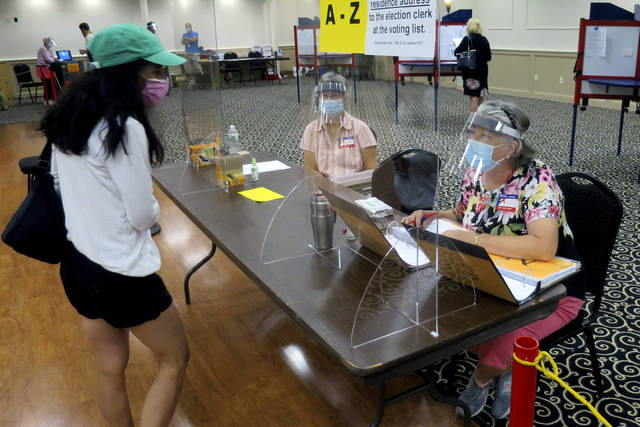
Plastic face shields stopped large droplets but allowed small particles to bolt from under the barrier and around its sides. Neck gaiters also were found not to be a good roadblock.
Vented masks, which have a disk that opens or closes when the wearer breathes in and out, also allowed particles to break free.
The best protection came from cotton masks with at least two layers of fabric, N95 masks and CVS surgical-grade face coverings.
Manhar Dhanak, a professor in FAU’s department of ocean and mechanical engineering, said the scientists sought to get answers to a problem we all face: how to defend ourselves from coronavirus and remain fairly comfortable.
“You always think about how effective your mask is,” Dhanak said. “That was one of our motivations.”
Dhanak said he was surprised to find particles escape from two-layer masks as well as ill-fitting N95 masks, which don’t fit snugly on some wearers.
“How well it fits on your face is so important,” he said. “They can leak from the sides or in gaps.”
To protect himself, Dhanak said he wears a nanofiber mask, similar to an N95, but “lighter and paper-thin.”
Soon FAU will have the results of another droplet barrier study. Dhanak is checking how well plexiglass separators — newly installed in schools, checkout counters and workplaces — are actually protecting the people behind the plastic. Publication is expected in the coming weeks.