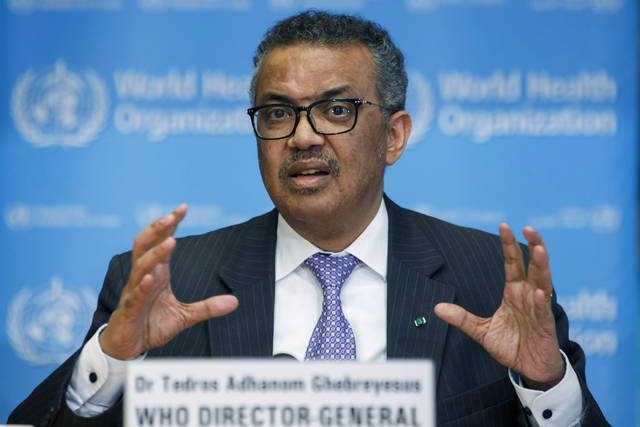
LONDON — The head of the World Health Organization warned against the idea that herd immunity might be a realistic strategy to stop the pandemic, dismissing such proposals as “simply unethical.”
At a media briefing on Monday, WHO Director-General Tedros Adhanom Ghebreyesus said health officials typically aim to achieve herd immunity by vaccination. Tedros noted that to obtain herd immunity from a highly infectious disease such as measles, for example, about 95% of the population must be immunized.
“Herd immunity is achieved by protecting people from a virus, not by exposing them to it,” he said. Some researchers have argued that allowing covid-19 to spread in populations that are not obviously vulnerable will help build up herd immunity and is a more realistic way to stop the pandemic, instead of the restrictive lockdowns that have proved economically devastating.
“Never in the history of public health has herd immunity been used as a strategy for responding to an outbreak,” Tedros said.
Tedros said that too little was known about immunity to covid-19 to know if herd immunity is even achievable.
“We have some clues, but we don’t have the complete picture,” he said, noting that WHO had documented instances of people becoming reinfected with coronavirus after recovering from an initial bout of the virus. Tedros said that while most people appear to develop some kind of immune response, it’s unclear how long that lasts or how robust that protection is — and that different people have varying responses.
“Allowing a dangerous virus that we don’t fully understand to run free is simply unethical,” he said.
WHO estimates less than 10% of the population has any immunity to the coronavirus, meaning the vast majority of the world remains susceptible.
Tedros also noted countries had reported record-high daily figures of covid-19 to the U.N. health agency for the last four days, citing surges in Europe and the Americas in particular.